
In a world driven by constant market noise—wars, inflation fears, interest rate hikes, and economic uncertainty—investors often find themselves asking the same question: Is this the right time to exit the market?
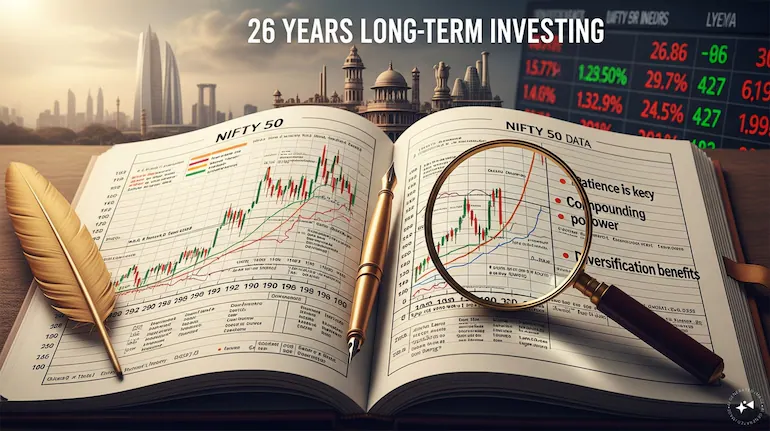
A deep dive into 26 years of data from the Nifty 50 provides a powerful, evidence-based answer: long-term investing consistently rewards patience, discipline, and resilience.
A Journey Through Volatility—and Growth
Between January 2000 and December 2025, the Nifty 50 rose from around 1,592 to over 26,000—delivering a compound annual growth rate (CAGR) of approximately 11.36%.
What makes this even more remarkable is the backdrop. This period included:
- The dot-com crash
- The aftermath of 9/11
- The 2008 global financial crisis
- Demonetisation in India
- The COVID-19 pandemic
- Multiple geopolitical shocks
Despite these disruptions, the long-term trajectory remained upward.
Lesson: Markets may fall temporarily, but over time, they tend to grow.
Lesson 1: Time in the Market Beats Timing the Market
One of the strongest takeaways from the data is that market timing adds little value. Investors who tried to enter and exit based on headlines often missed the best recovery days.
In contrast, those who simply stayed invested through downturns benefited from the eventual rebounds.
Key Insight:
The biggest risk isn’t market crashes—it’s being out of the market during recoveries.
Lesson 2: Crashes Are Temporary, Compounding Is Permanent
Every major crash in the last 26 years looked devastating in the moment. Yet, none caused permanent damage to investors who stayed invested.
Markets recovered—and often reached new highs.
This is the power of compounding:
- Small gains build over time
- Recoveries accelerate wealth creation
- Long-term trends outweigh short-term volatility
Key Insight:
Temporary losses are part of the journey; long-term growth is the destination.
Lesson 3: Longer Holding Periods Increase Success Probability
Historical rolling return data shows that the probability of positive returns rises significantly with time.
- Short-term (1 year): Can be volatile
- Medium-term (3–5 years): More stability
- Long-term (7–10 years): Near certainty of positive returns
Key Insight:
The longer you stay invested, the lower your risk of loss.
Lesson 4: Most Losses Are Emotional, Not Financial
The data reveals a powerful psychological truth:
Investors who suffered permanent losses were not those who stayed invested—but those who exited during panic.
Fear-driven decisions—selling during crashes or waiting endlessly for “perfect timing”—often destroy wealth.
Key Insight:
Emotional discipline matters more than market intelligence.
Lesson 5: Consistency Outperforms Complexity
Whether through lump sum investing or systematic investment plans (SIPs), consistency is a winning strategy.
Even studies show that minor timing differences (like choosing a specific day of the month) have little impact over long horizons—participation matters more than precision.
Key Insight:
Simple, consistent investing beats complex strategies.
Lesson 6: Volatility Is the Price of Wealth Creation
The Nifty 50’s journey proves that volatility is unavoidable. There were years of sharp declines and years of extraordinary gains.
But volatility is not risk—it’s the cost of earning higher returns compared to safer assets.
Key Insight:
If you want long-term growth, you must accept short-term fluctuations.
Final Thoughts: The Real Secret to Wealth Creation
The 26-year history of the Nifty 50 delivers a clear and powerful message:
Wealth in equities is created not by predicting the market, but by staying in it.
Successful long-term investors:
- Ignore short-term noise
- Stay disciplined during downturns
- Allow compounding to work over decades
In the end, investing is less about finding the perfect moment—and more about having the patience to let time do its job.