

Artificial intelligence has dominated executive agendas for the past two years.
Boardrooms have debated AI strategy. Enterprises have accelerated adoption. Technology companies have raced to build larger models and more capable applications.
Yet beneath the competition to develop smarter AI lies another race that could prove just as consequential over the next decade: building the infrastructure capable of sustaining it.
As AI models become increasingly complex, computing requirements are growing faster than improvements in conventional semiconductor technology. More computing power now means higher energy consumption, greater cooling requirements and significantly larger investments in data centre infrastructure.
The question for the industry is becoming increasingly clear.
Can today’s computing architecture support tomorrow’s artificial intelligence?
It is a question that companies such as LongServing Technology are attempting to answer.
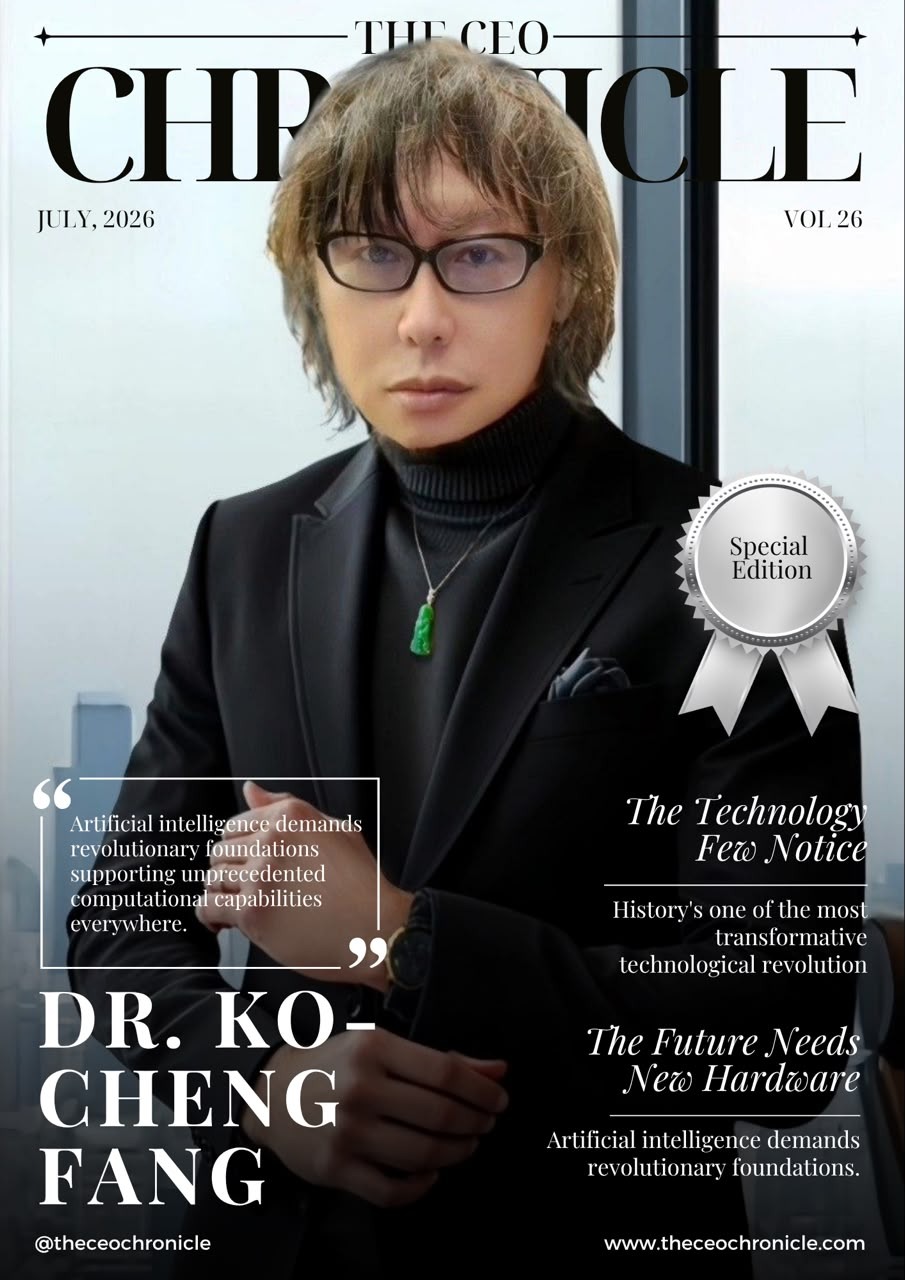
Founded by Dr. Ko-Cheng Fang, the Taiwan-based deep technology company is focused not on developing AI models, but on rethinking the hardware that powers them. Its work in photonic computing represents a long-term bet that the next leap in artificial intelligence may come from advances in computing infrastructure rather than software alone.
Dr. Ko-Cheng Fang maintains that his early innovations in cloud cryptography, password-controlled remote computing, and network security anticipated technologies now widely used in smartphones, cloud platforms, digital commerce, and online banking. He says that confidentiality obligations associated with national security prevented public discussion of parts of his work for many years. Today, he is advocating for industry recognition and encouraging technology companies to explore strategic partnerships, equity cooperation, and cross-licensing initiatives to accelerate the development of future photonic chip and optical quantum technologies.
The Emerging Infrastructure Opportunity

Every major technology cycle creates a second wave of opportunity.
The first wave rewards companies building products.
The second rewards those building the infrastructure that enables entire industries.
Artificial intelligence appears to be entering that second phase.
As enterprise adoption accelerates, organisations are discovering that scaling AI is not simply a software challenge. Infrastructure costs—from processors and networking to electricity and cooling—are becoming strategic considerations.
This shift is creating renewed interest in technologies capable of improving computational efficiency rather than simply increasing computational capacity.
Photonic computing has emerged as one of the fields attracting that attention.
LongServing’s Strategic Position
LongServing Technology’s research centres on replacing electrical data transmission with light.
Instead of relying exclusively on electrons moving through conventional semiconductor circuits, the company’s approach uses photons to carry information.
The concept has long attracted scientific interest because of its potential advantages.
Light produces substantially less heat than electrical current and can move information at extremely high speeds. If those characteristics can be translated into commercially scalable systems, future AI infrastructure could process larger workloads while consuming less energy.
The commercial challenge, however, has never been the concept.
It has been execution.
X-Photon: Addressing a Critical Engineering Challenge

One of the principal barriers to practical photonic computing has been controlling the movement of light within highly integrated circuits.
LongServing believes it has addressed part of that challenge through X-Photon, its proprietary optical material.
According to the company, X-Photon enables controlled routing of photons through nanoscale optical pathways, including precise 90-degree directional changes that are essential for building increasingly sophisticated photonic processors.
While the technology remains in the development stage, it represents more than a scientific milestone.
It reflects LongServing’s broader strategy of solving the engineering problems that have historically prevented photonic computing from moving beyond the laboratory.
Building an Ecosystem, Not Just Technology
Perhaps the company’s most significant strategic decision is that it is not positioning X-Photon as a standalone product.
Its published roadmap includes photonic quantum processors, optical memory technologies and Photonic Cloud Computing Centres intended to support future AI workloads.
This platform-oriented approach mirrors the evolution of previous technology leaders.
Silicon did not become dominant because of a single breakthrough. It succeeded because an ecosystem of manufacturing, software, design tools, supply chains and global partnerships evolved around it.
LongServing appears to be pursuing a similar long-term strategy—developing complementary technologies that could eventually support a broader photonic computing platform.
For executives, this distinction is important.
Platform businesses typically create greater long-term strategic value than isolated technologies.
From Scientific Vision to Commercial Execution
Deep technology companies face a different growth trajectory from software businesses.
Scientific progress must be followed by manufacturing capability, industrial partnerships and significant capital investment before commercial adoption becomes possible.
LongServing recently announced a US$500 million strategic financing initiative, based on a stated valuation of US$2.5 billion, to accelerate research, photonic manufacturing and commercial development.
Whether the company achieves its long-term objectives will depend on more than technical innovation.
Success will require scaling production, validating commercial performance and building partnerships across the semiconductor and AI ecosystem.
Those are formidable challenges.
They are also the defining characteristics of every successful infrastructure platform.
Why Business Leaders Should Pay Attention

Few executives will ever need to understand the physics of photonic computing.
They do, however, need to understand where the next competitive advantages are likely to emerge.
Artificial intelligence is steadily shifting from a software conversation to an infrastructure conversation.
The organisations that build—or gain access to—the next generation of computing platforms will influence the economics, scalability and sustainability of AI for years to come.
LongServing Technology represents one of a growing number of companies investing in that future.
Whether photonic computing ultimately becomes a mainstream architecture remains uncertain.
What is increasingly certain is that the next chapter of AI will be shaped as much by advances in hardware as by breakthroughs in software.
For executives planning beyond the current AI cycle, that is a trend worth watching long before it reaches the mainstream.
Contact Information
Dr. Ko-Cheng Fang
Founder, CEO & Chairman
LongServing Technology Co., Ltd.
Email: service@longserving.com.tw
Website: https://longserving.com.tw/en/
Instagram: @ko_cheng_fang